.avif)
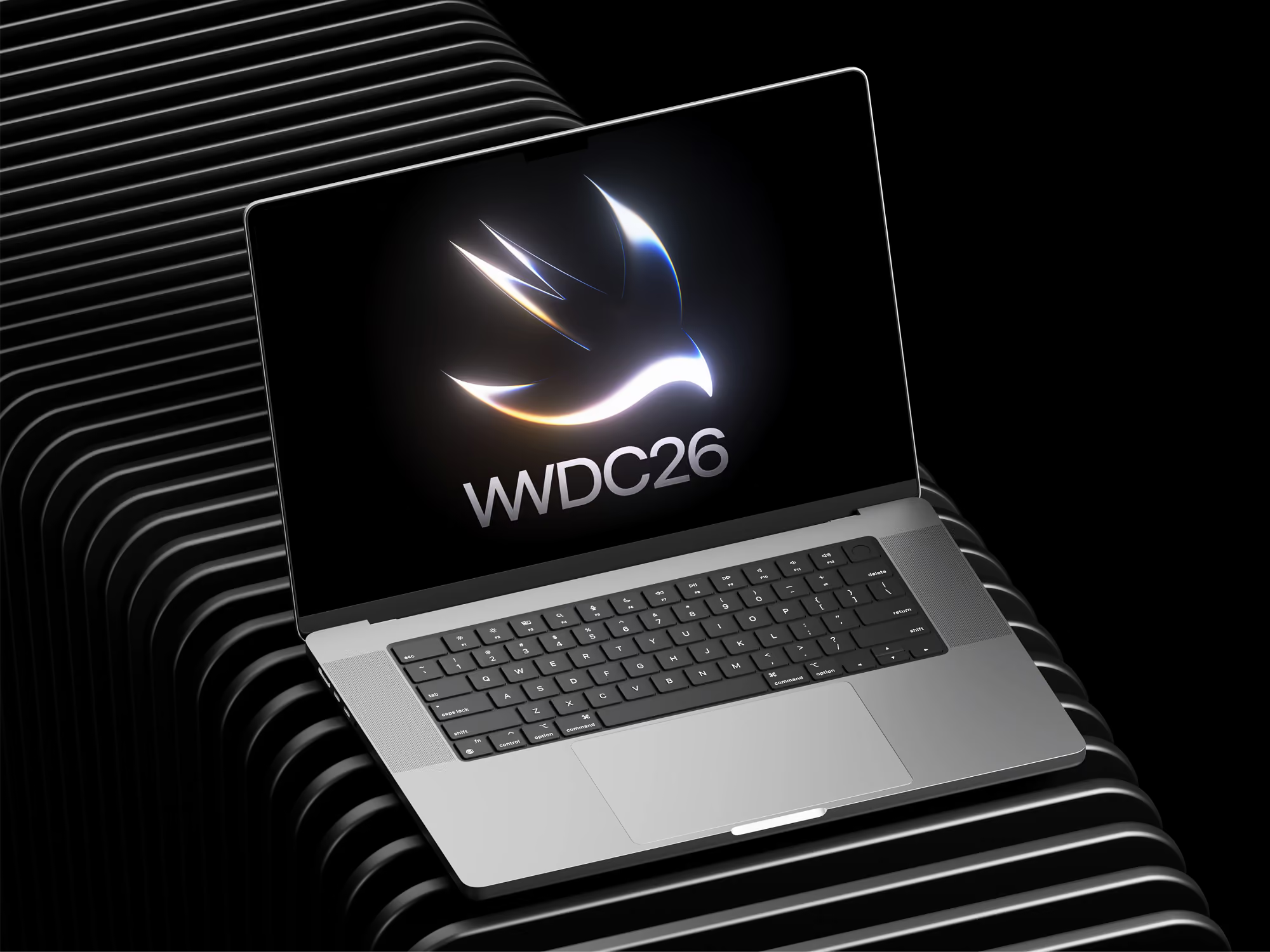
Our predictions for the announcements that will reshape app design in 2026.
WWDC 2026: Here's What to Expect and Why It Matters for Your App
WWDC 2025 gave us Liquid Glass, and every iOS app we've shipped since has had to reckon with translucency, depth, and that iridescent shimmer.
WWDC 2026 kicks off Monday, June 8th, with the keynote at 10 a.m. PT and Platforms State of the Union at 1 p.m. PT. And the rumors have been louder than usual.
Apple Intelligence finally catching up. A real refinement of Liquid Glass after a year of designer feedback. A meaningful visionOS update. A health-first watchOS 27. And the persistent whisper of a lighter, glasses-form-factor Vision device meant to challenge Meta's RayBan Display.
The official tagline, "Coming bright up," is itself a tell. Apple's WWDC taglines tend to preview the design direction, and "bright" reads as a doubling-down on the luminous, translucent Liquid Glass family rather than a pivot. Whatever Apple is shipping, it wants you to feel the light.
We've been tracking the signals across rumor reports, supply chain leaks, and Apple's own developer documentation. Here are the four predictions we'd bet on, and what each one means if you're shipping an iOS, iPadOS, watchOS, or visionOS app in the next 12 months.
🍎 WWDC drops June 8th. Will your app be ready, or playing catch-up by July? Let's talk now.
1. Apple Intelligence 2.0: The Year Apple Stops Playing Catch-Up
Apple Intelligence launched in 2024 with promise but underwhelmed in execution. Siri felt half-rewritten. The agentic Siri Apple demoed in 2024 got delayed past iOS 26. And by late 2025, Google's Gemini and OpenAI's GPT-5 had opened a real gap.
WWDC 2026 is where Apple has to close it.
What we expect Apple to announce
A fully agentic Siri capable of actually completing multi-step tasks across apps. Booking flights, drafting replies that pull from your calendar, summarizing your week from Mail and Messages. The kind of cross-app intelligence that requires deep system access, and the kind only Apple can ship at OS level.
We also expect a new on-device foundation model with better reasoning, a public-facing Apple Intelligence API for third-party developers, and tighter integration with Claude or ChatGPT for the heavier reasoning tasks the on-device model can't handle.
What it means for your app
If you ship in the Apple ecosystem, you need to start thinking about your app as something an AI agent will operate, not just a user. That means semantic structure in your views, clear and unambiguous CTAs, and App Intents that Siri can actually invoke. The shift toward agentic UX is already underway, and WWDC is where it becomes table stakes on iOS.
2. Liquid Glass 2.0: Where the Design Language Goes Next
Liquid Glass was the boldest visual reset Apple has done since iOS 7. Translucent layers, refractive depth, dynamic motion that responds to content underneath. A year in, we've seen the strengths (premium feel, modern hierarchy) and the weaknesses (legibility in cluttered states, accessibility friction, performance hits on older devices).
WWDC 2026 will be where Apple refines, not reinvents.
What we expect
Smarter contrast handling. The current Liquid Glass struggles when content behind a panel is busy. Expect Apple to introduce adaptive opacity that responds to underlying complexity, the way Auto Wallpaper already adjusts text color.
We also expect new motion primitives. Liquid Glass is a visual language, not yet a motion language. WWDC 2026 should be where Apple ships system-level motion behaviors that snap, settle, and ripple in consistent ways across apps.
Finally, expect a real component library. Designers have been reverse-engineering Liquid Glass in Figma for a year. Apple should ship official kits, tokens, and SwiftUI primitives that make consistency easier and divergence less likely.
What it means for your app
If your design system still feels like flat iOS, you're already a generation behind. Audit your spacing, your depth model, your handling of translucent surfaces. The teams shipping the most premium-feeling iOS apps in 2026 have already adopted Liquid Glass conventions. WWDC is where the rest of the market catches up. Or gets left behind.
3. The Spatial Computing Question: Is This the Glasses Year?
The Vision Pro is two years old and still hasn't found mainstream traction. Meanwhile, RayBan Meta Display launched at $799 in September 2025 and has been quietly winning the ambient computing argument. The philosophical split between the two devices is one we've been thinking about a lot, and WWDC 2026 is where Apple has to pick a side.
What we expect
A significant visionOS update aimed at developers, not consumers. Better spatial widget primitives, improved hand tracking APIs, and a strong push for spatial productivity apps. Apple needs the platform to feel less like a $3,499 luxury and more like the future of work.
We're 60/40 on Apple announcing or teasing a glasses-form-factor product. The supply chain rumors have been consistent for months. If Apple does tease it, expect a developer beta of "visionOS for glasses" with a focus on glanceable notifications, navigation overlays, and live translation. The ambient computing playbook Meta has been writing.
What it means for your app
If you've been waiting to commit to spatial design, this is the year you stop waiting. Vision Pro app adoption has been slow precisely because developers wanted to see Apple's next move. WWDC 2026 should give clearer signals, and clearer SDK tooling, for either path. Our spatial computing and XR design team has been prototyping for both paradigms, and the principles hold regardless of which one Apple commits to.
4. watchOS 27: Health Goes Predictive
Apple Watch Series 11 brought hypertension alerts. Series 12, expected this September alongside iPhone 18, is rumored to add even more passive health monitoring. WWDC 2026 will reveal the OS that ties it all together.
What we expect
A redesigned Health app with predictive insights, not just retrospective ones. AI summarizing trends, flagging anomalies, and recommending interventions. The Watch finally graduating from "tracker" to "early warning system."
We also expect deeper third-party access to health data through new HealthKit APIs, more aggressive use of the Smart Stack on watchOS, and a refined Liquid Glass layer built specifically for the wrist (the current implementation works on the 45mm screen but doesn't quite earn its translucency).
What it means for your app
If you're in health, fitness, or wellness, this is the WWDC that matters most for you. The data you can pull from HealthKit is about to expand. The interaction patterns for glanceable Watch UI are about to evolve. And the bar for "premium health app" is about to get higher.
What Designers Should Be Doing Right Now
The week of WWDC always feels like a fire drill. Newdesign language, new APIs, new patterns, all dropping at once. Here's how the teams we work with are preparing.
They're auditing their existing apps against Liquid Glass conventions, not waiting for the 2.0 refresh. They're rethinking IA for agentic AI, so Siri can actually navigate their products. They're prototyping for spatial form factors, even if they don't ship to Vision Pro yet. And they're building design systems that can absorb new tokens and primitives without a full redesign.
WWDC 2026 won't be a quiet year. It's the conference where Apple either reclaims the AI narrative or cedes it for good. It's where Liquid Glass either solidifies or starts feeling dated. And it's where the spatial computing bet either pays off or pivots.
We'll be watching. And we'll publish a follow-up breaking down what actually shipped, where Apple over-delivered, and where the gap between expectation and reality reveals what to design around.
Key Takeaways
- WWDC 2026 will likely be Apple's "AI catch-up" moment, with a fully agentic Siri and a new on-device foundation model expected.
- Liquid Glass should evolve, not reinvent. Expect adaptive opacity, motion primitives, and an official component library.
- Spatial computing announcements are the wildcard. A glasses-form-factor tease would reframe the entire category.
- watchOS 27 will likely push the Watch from tracker to predictive health platform, with expanded HealthKit APIs for third-party developers.
- Designers shipping Apple apps should audit Liquid Glass adoption, rethink IA for AI agents, and prototype for spatial form factors now.
- Generative UI patterns and agentic-friendly app structure will be table stakes by the end of 2026.
- The teams who prepare for WWDC's shifts before the keynote will ship faster than the teams who react after.
We've already started prototyping for what's coming. Want us prototyping for you? Get in touch 🚀
FAQ
What is WWDC?
WWDC stands for Apple Worldwide Developers Conference. It's Apple's annual event where the company announces major updates to iOS, iPadOS, macOS, watchOS, tvOS, and visionOS. Developers also get access to new APIs, design guidelines, and tooling that shape Apple platforms for the year ahead.
When is WWDC 2026?
WWDC 2026 runs from June 8 to June 12, 2026, all online and free. The opening keynote takes place on Monday, June 8 at 10 a.m. PT, followed by the Platforms State of the Union at 1 p.m. PT. Apple streams both sessions on its developer site, the Apple Developer app, the Apple TV app, and YouTube.
What is Apple Intelligence 2.0?
Apple Intelligence 2.0 is the rumored next generation of Apple's AI platform. It's expected to add agentic capabilities to Siri, deeper integration with third-party apps, and a more capable on-device foundation model. We expect Apple to position it as a direct response to Google Gemini and OpenAI's GPT-5.
What is Liquid Glass?
Liquid Glass is Apple's design language introduced at WWDC 2025. It uses translucent layers, refractive depth, and dynamic motion to create a sense of physical glass surfaces within the UI. It rolled out across iOS 26, iPadOS 26, watchOS 26, and macOS Tahoe in late 2025.
Will Apple announce smart glasses at WWDC 2026?
Maybe. Supply chain rumors suggest Apple is working on a glasses-form-factor product to compete with Meta's RayBan Display. WWDC 2026 would be a logical place for a developer-focused tease, even if the consumer launch is further out. We rate it at 60/40 odds.
What will watchOS 27 include?
watchOS 27 is expected to focus on predictive health, with AI summarizing trends and flagging anomalies before they become problems. Expect expanded HealthKit APIs, a redesigned Health app, and a refined Liquid Glass layer built for the wrist.
How should designers prepare for WWDC 2026?
Audit your app against Liquid Glass conventions, rethink your information architecture so AI agents can navigate your product, and start prototyping for spatial form factors even if you don't ship to Vision Pro today. The teams that prepare before the keynote ship faster than the teams that react after.
How does WWDC 2026 affect non-Apple apps?
WWDC sets the design and interaction standards users come to expect across every platform. Even if you ship cross-platform or web-only, the patterns Apple introduces shape user expectations. Liquid Glass aesthetics are already showing up in web UIs designed in 2026, and agentic features will follow the same path.
Where can I watch the WWDC 2026 keynote?
The keynote streams free on Apple's website, the Apple Developer app, the Apple TV app, and YouTube. It starts at 10 AM Pacific on Monday, June 8, 2026. Session videos are usually posted within hours of the keynote.

Keep Reading
More from Orizon

Let's Talk
Design done right and fast by
people you can trust.


%20(1).avif)




.svg)


.svg)