.avif)

One wants to disappear into your life. The other wants to replace it. Both are right.
RayBan Meta vs Apple Vision Pro: Two Philosophies of Spatial Design
Two devices. One question: what should spatial computing actually feel like?
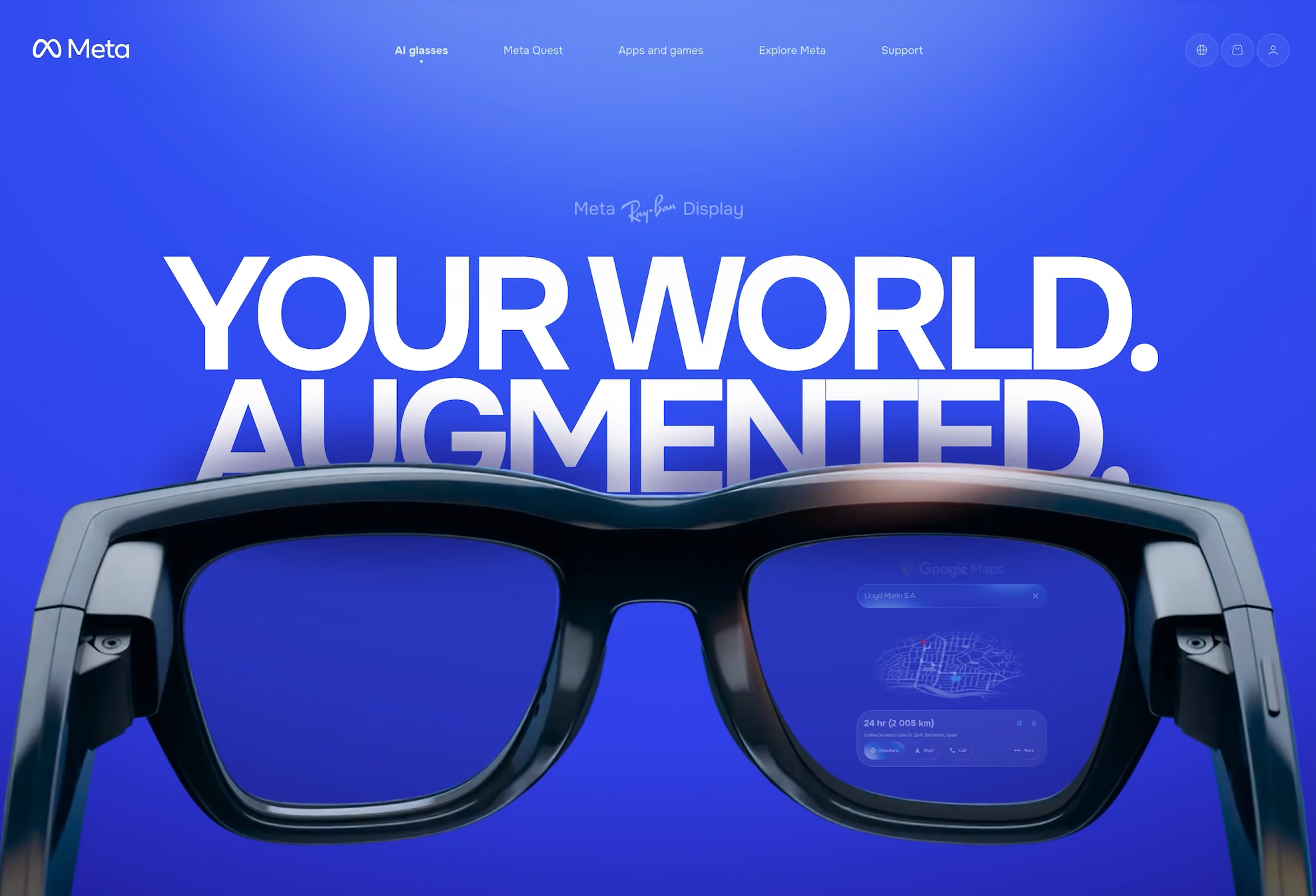
Ray-Ban Meta Display launched in September 2025 at $799 - lightweight Wayfarer frames with a discreet in-lens display, an EMG wristband you control with subtle finger twitches, and AI baked into every interaction.
Apple Vision Pro got refreshed in October 2025 with the M5 chip, a more comfortable Dual Knit Band, and a 120Hz refresh rate. The price stayed at $3,499. Then at WWDC 2026 last week, Apple announced visionOS 27 - and made clear they're still betting on the headset, not glasses.
Two devices. Two completely different philosophies. And the gap between them just got bigger.
🥽 Designing for spatial, AR, or XR platforms? Let's build something worth looking at →
Philosophy 1: Disappear into the world (Ray-Ban Meta)
Meta's entire bet is ambient computing - technology that enhances your reality without pulling you out of it. The Ray-Ban Display puts a 600×600 pixel screen with a 20-degree field of view off to the right edge of your vision. It's there when you want it, invisible when you don't.
Navigation, live captions, AI answers, messages, real-time translation - all delivered in a glance, while you stay present. The Meta Neural Band means you don't even touch the frames. A subtle finger pinch controls everything via muscle signals detected at your wrist, with up to 18 hours of battery life.
The design philosophy is radical minimalism: the best interface is the one you forget is there. It's a principle our Spatial Computing & XR Design team has championed for years, and seeing it built into consumer hardware is exciting.
Philosophy 2: Step inside a new reality (Apple Vision Pro)
Apple Vision Pro goes the opposite direction. It doesn't want to supplement your world, it wants to be your world. Infinite screen space. Spatial apps. Immersive environments. A computing experience that's fully spatial, fully intentional, and completely yours.
The UX philosophy here is intentional immersion. When you put on Vision Pro, you're choosing to enter a focused computing state. It's not ambient. It demands presence. And in return, it gives you something no flat screen can: depth, scale, and spatial context.
It's the difference between a whisper in your ear and a room you walk into. At Orizon, we offer dedicated Apple Vision Pro UX design services, transforming traditional 2D interfaces into dynamic 3D spatial experiences. If you're building for Vision Pro, this is exactly what we do.
What WWDC 2026 just confirmed
If anyone thought Apple was about to hedge into the ambient glasses lane, WWDC 2026 ended that theory.
visionOS 27 launches this fall with three big additions: a redesigned Siri AI with deeper contextual awareness, Visual Intelligence (ask Siri questions about what you're looking at inside the headset), and Spatial Reframing (turn your own panoramic photos into immersive environments you can step into).
Notice what's missing? Any mention of smart glasses. Apple stayed completely silent on ambient wearables. Every announcement doubled down on the headset: more immersion, more spatial context, more reasons to put the device on your face.
For designers, the signal is clear. Apple isn't trying to compete with Meta on Meta's terms. Visual Intelligence inside the headset is the opposite of glanceable AI on the edge of your vision - it's AI that understands the spatial environment you're already inside. Two paths. No convergence.

What they share, and what designers can learn
Different as they are, both devices solve the same core UX problem: reducing the friction between thinking and doing.
Neither wants you fighting an interface. Both remove the phone from the equation. Both bet that the future of computing is worn, not held.
We've been prototyping for both paradigms across AR retail concepts, VR workspaces, and spatial collaboration tools, and the core design principles hold regardless of platform: keep cognitive load low, make interactions feel natural, and never let the interface become the obstacle.

The real design question isn't which is better
It's what moment are you designing for?
A quick navigation cue during a walk? Ray-Ban's ambient layer wins. A deep-focus creative session, spatial presentation, or 3D collaboration? Vision Pro's immersive environment wins.
The mistake would be applying one philosophy to the wrong context. Cramming an immersive spatial app into glasses meant to disappear. Building a lightweight notification layer into a headset built for depth.
At Orizon, this is exactly the kind of spatial UX challenge we love. Figuring out what kind of experience belongs on what kind of platform, and designing it to feel inevitable. We've been exploring AR/VR concepts since well before these devices shipped, and the principles we developed then are proving out now.
The platform doesn't define the experience. The intention does.
Key Takeaways
- Ray-Ban Meta Display ($799) represents ambient computing: tech that enhances life without demanding attention
- Apple Vision Pro M5 ($3,499) represents intentional immersion: a full spatial computing environment
- WWDC 2026 confirmed Apple is doubling down on the headset paradigm with visionOS 27, not pivoting to glasses
- visionOS 27 adds a redesigned Siri AI, Visual Intelligence, and Spatial Reframing
- Both devices solve the same core problem: reducing friction between thinking and doing
- The right platform depends on the moment you're designing for, not which device is "better"
- Designing for either paradigm requires the same fundamentals: low cognitive load, natural interaction, invisible interface
Ready to design for spatial computing before your competitors do? Contact us today 🚀
FAQs
How much does Ray-Ban Meta Display cost in 2026?
Ray-Ban Meta Display launched in September 2025 at $799 and is still selling at that price in 2026. The price includes the glasses and the Meta Neural Band wristband for gesture control. It sits at roughly a quarter of the price of Apple Vision Pro.
How much does Apple Vision Pro cost in 2026?
Apple Vision Pro M5 starts at $3,499 for the 256GB model, with 512GB at $3,700 and 1TB at $3,900. Apple refreshed the device in October 2025 with the M5 chip and Dual Knit Band, but kept the same starting price as the original 2024 launch.
What is the difference between Ray-Ban Meta Display and Apple Vision Pro?
Ray-Ban Meta Display is a pair of lightweight smart glasses with a small in-lens display designed to enhance your everyday life without pulling you out of it. Apple Vision Pro is a full spatial computing headset that creates an immersive computing environment over your eyes. One is ambient, the other is intentionally immersive.
What did Apple announce for Vision Pro at WWDC 2026?
Apple announced visionOS 27, shipping this fall. The update introduces a redesigned Siri AI with deeper contextual awareness, Visual Intelligence (ask Siri about what you're seeing inside the headset), and Spatial Reframing (turn flat panoramic photos into immersive environments). Notably, Apple announced no smart glasses, signaling they're staying focused on the headset paradigm.
What is ambient computing?
Ambient computing is technology that enhances your reality without demanding your full attention or pulling you out of the present moment. Ray-Ban Meta Display is a leading example, delivering navigation, captions, and AI answers in a glance. The design goal is for the interface to almost disappear.
What is spatial computing?
Spatial computing is a category of computing that uses depth, scale, and 3D space as core parts of the interface. Apple Vision Pro is the clearest consumer example, placing apps and environments around the user. It treats the space around you as the canvas, not a flat screen.
Which is better for designers to build for, Ray-Ban Meta or Apple Vision Pro?
Neither is universally better. Ray-Ban Meta is the right platform for glanceable, ambient experiences like navigation, live captions, or quick AI answers. Apple Vision Pro is the right platform for immersive, focused experiences like spatial presentations, creative tools, or 3D collaboration.
What is the Meta Neural Band on Ray-Ban Meta Display?
The Meta Neural Band is an EMG wristband that detects muscle signals at your wrist, letting you control the glasses with subtle finger pinches and twitches. You never need to touch the frames or pull out a phone. It offers up to 18 hours of battery life and is a major part of why the device feels ambient rather than intrusive.
What is Visual Intelligence in visionOS 27?
Visual Intelligence lets Vision Pro users ask Siri questions about objects, content, and information currently visible inside the headset. It builds on Apple's broader AI strategy of contextual awareness across the ecosystem. Inside Vision Pro, it makes the spatial environment itself queryable.
Will smart glasses replace smartphones and headsets?
Not immediately, but both Meta and Apple are betting the future of computing is worn, not held. Smart glasses will likely take over short, glanceable interactions first, like messages, navigation, and AI queries. Headsets will own deep-focus and immersive work. Phones stick around for everything in between.
What UX principles apply across both ambient and immersive spatial design?
Three principles hold regardless of platform: keep cognitive load low, make interactions feel natural, and never let the interface become the obstacle. The difference between the two paradigms is when and how attention is demanded, not the underlying design fundamentals. Good spatial UX always reduces friction between thinking and doing.
Where can I find a UX team that designs for spatial computing and AR/VR?
Orizon offers dedicated Apple Vision Pro UX design services and a Spatial Computing & XR Design team that has been prototyping for both ambient and immersive paradigms since before these devices shipped. Book a call to discuss your spatial project here: www.orizon.co/contact-us
Header image: Photo by Fulcrum Rocks - Mobile for Fulcrum Rocks / Dribbble – “Meta Smart Glasses Apps” (Shot #26693434).

Keep Reading
More from Orizon



%20(1).avif)




.svg)


.svg)