.avif)
Where National Security Meets Silicon Valley Craft
Top 10 Defense Tech Websites in 2026
Why Defense Tech Website Design Matters More Than Any Other B2B Category
Defense tech startups raised $14.6 billion in the first five months of 2026, already past 2025's full-year record of $9.6 billion, and the DoD's "Drone Dominance" Program is now targeting more than 300,000 domestically-produced drones by 2027. That capital and that mandate are landing on a very small group of companies. Anduril alone is at a $61 billion valuation, Shield AI at $12.7 billion, Saronic at $9.25 billion. The gap between the top of the market and everyone else is widening every quarter, and the first read almost always happens on a website before a single meeting is booked.
Defense is one of the only categories where the buyer has to trust the technology before they can trust the business. A DoD program manager, a NATO procurement lead, or a late-stage investor is doing a credibility scan on your homepage in seconds. Can this company actually build hardware. Do they understand the mission. Are they software-first or PowerPoint-first. The best defense tech sites answer those questions before the fold: real product screens, real platforms, real deployment context, and a hierarchy that treats the mission as the story, not the decoration.
Most defense sites still get this wrong. Stock photos of soldiers with rifles, black backgrounds with gradient meshes, vague headlines about "protecting the free world," a product page that looks like a Wikipedia article. The ones below do the opposite. They're specific, calm, and confident. And they all share the same design pattern: a full-bleed opening animation, then scroll-triggered motion that walks you through the product story as you move down the page.
🛡️ Designing for defense or dual-use? Let's build the site your product deserves →
The Shortlist
- Vatn - autonomous underwater vehicles built for the subsea domain
- Overland AI - off-road autonomy for unmanned ground vehicles in complex terrain
- Saronic - autonomous surface vessels reshaping the maritime domain
- Shield AI - Hivemind, the AI pilot that flies aircraft in GPS-denied environments
- Palantir - the software backbone of modern intelligence, on track for over $8 billion in 2026 revenue
- Anduril - the new prime, autonomous systems and the Lattice software layer that ties them together
- Castelion - low-cost hypersonics from ex-SpaceX engineers, $13 billion and climbing
- Epirus - directed energy for counter-electronics
- Helsing - Europe's sovereign defense AI story, now valued at $18 billion
- Applied Intuition - the autonomy toolchain now bridging commercial and defense
What Makes a Great Defense Tech Website in 2026
The category has its own rules, and the top ten sites now share one clear pattern: a full-bleed opening animation, then scroll-triggered motion that reveals the product as you move down the page. Here's what the sites that break through do:
- A full-bleed opening animation that sets the domain in seconds. Vatn opens underwater. Overland opens off-road. Castelion opens with a launch. The animation is the new hero image.
- Scroll-triggered motion that reveals the product in sequence. Systems appear as you scroll, specs animate in, capabilities unfold in the order the buyer needs. Brochure becomes briefing.
- Positioning that names the mission. Not "empowering the warfighter." Something specific like "autonomous aircraft in GPS-denied environments." Vague copy gets skimmed. Specific copy gets sent internally.
- Real product over stock warfare imagery. Actual drones, actual command consoles, actual telemetry. Stock photos of soldiers with rifles are a tell that the product isn't ready to be shown.
- Motion discipline everywhere else. Opening animation and scroll motion only work when hover states, transitions, and micro-interactions stay quiet. Too much motion and the site reads as a video game trailer.
- Trust signals placed with restraint. Contract wins and service branch logos surface contextually, not stamped across the hero.
- Performance that matches the product story. Animation-heavy sites make this harder, so the best ones treat load time as part of the engineering story.
The 10 Defense Tech Websites Worth Studying
1. Vatn

What they do: Vatn builds autonomous underwater vehicles for defense and dual-use maritime missions. The focus is low-cost, mass-producible subsea systems for ISR and other undersea work, a domain most defense tech companies still ignore in favor of aerial and surface autonomy.
Why the site works: Vatn opens with a full-bleed underwater animation that establishes the domain in one shot, then hands the story off to a scroll-triggered sequence that reveals platforms, mission profiles, and capabilities as you move down the page. The palette leans into deep blacks and subsea blues, and the typography stays quiet so the motion carries the weight. It's a rare site where the design vocabulary genuinely feels domain-native rather than borrowed from aerospace.
Best for: Hardware companies working in overlooked domains where the site has to teach the reader why the domain matters before selling the product.
2. Overland AI

What they do: Overland AI builds autonomy software for unmanned ground vehicles operating off-road in contested and unstructured terrain, the environments where GPS and lane markings don't exist. Seattle-based, founded by robotics veterans out of the University of Washington's autonomy program.
Why the site works: Overland uses an opening motion sequence of vehicles moving through real off-road terrain to make the problem obvious before a single word does the work. As you scroll, the site pulls you through the technical stack in a sequence that mirrors how the autonomy actually operates: perception, planning, control. Real footage over rendered demos. Typography is engineering-forward without tipping into cliche.
Best for: Deep tech companies where the environment itself is part of the pitch and the site needs motion to communicate what a screenshot can't.
3. Saronic

What they do: Saronic builds autonomous surface vessels for military and commercial maritime work. Founded in 2022 by a former Navy SEAL, the company closed a $1.75B Series D in March 2026 at a $9.25B valuation, one of the largest defense tech rounds outside Anduril itself.
Why the site works: The site treats the ocean as the design system. Deep blues, real vessel photography, and a product hierarchy that walks readers from the Spyglass to the Corsair to the Marauder in a way that mirrors mission scale. There's real restraint in how the site talks about autonomy, avoiding the sci-fi language that plagues the maritime category. It reads like a serious shipbuilder that happens to be software-first.
Best for: Hardware companies with a narrow domain who want their site to feel category-defining rather than category-competitive.
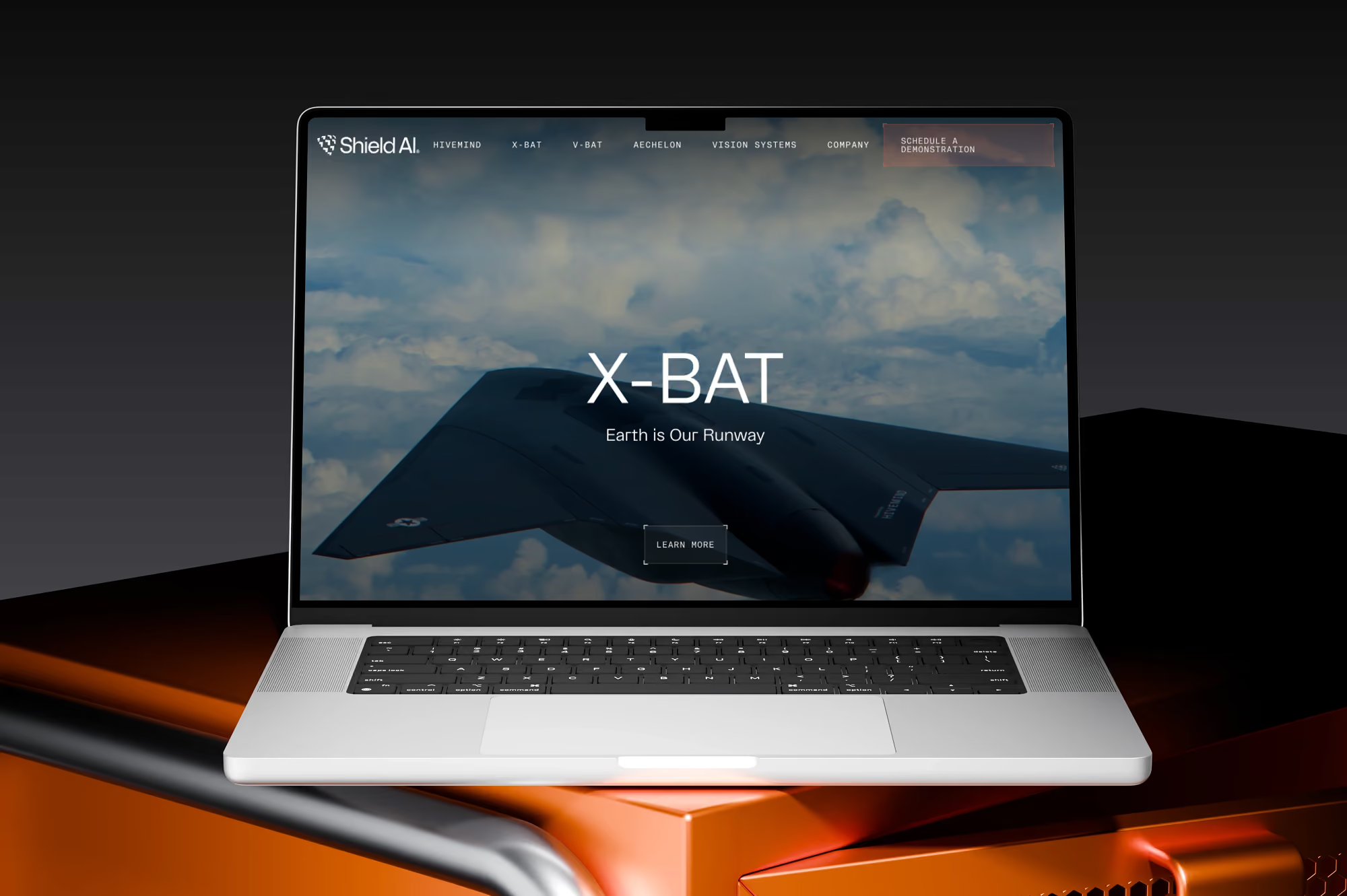
4. Shield AI

What they do: Shield AI builds Hivemind, an autonomy stack that flies aircraft in GPS-denied and contested environments, and the V-BAT vertical takeoff drone. A $1.5B Series G in March 2026 valued the company at $12.7 billion. In February 2026, its Hivemind stack flew Anduril's Fury aircraft in the US Air Force's Collaborative Combat Aircraft program.
Why the site works: Shield AI's site leans into the drama of the mission without tipping into theatrics. The Hivemind product page is one of the clearest explainers of autonomy software in the category, using a mix of cinematic footage and technical diagrams to explain what an "AI pilot" actually is. The typography is aviation-inspired without being retro, and the case studies name specific programs and specific customers.
Best for: Software companies selling to buyers who need to see the product operating in the real environment, not a rendered one.
5. Anduril

What they do: Anduril is the defining defense tech company of the decade. Founded in 2017 by Palmer Luckey and now with over 8,000 employees, it builds autonomous systems, counter-drone hardware, and the Lattice software platform that ties them together. A $5B Series H in May 2026 valued the company at $61B, putting it in the tier of a new-generation prime contractor.
Why the site works: Anduril's site is a masterclass in confident restraint. The palette is near monochrome, the typography is disciplined, and the hero copy states the mission in a single line. Product pages for Fury, Roadrunner, Ghost, and Lattice each read like a small dedicated site, with real cinematography and specs presented like a serious defense catalog rather than a startup landing page. The "Rebooting the Arsenal of Democracy" manifesto page shows a rare thing in the category: a company willing to make its worldview part of the interface.
Best for: Any defense or deep tech company that wants to signal seriousness without falling into contractor cliches.
6. Palantir

What they do: Palantir is the software backbone of modern government intelligence and enterprise operations, building Foundry, Gotham, and the AIP platform that now sits inside a growing share of defense and commercial AI stacks. The company is on track for over $8 billion in 2026 revenue, an 82% jump, with US commercial revenue growing 149% year-over-year.
Why the site works: Palantir's site is understated to the point of quiet. The design language is monochromatic and typographic, the case studies are treated like investigative journalism instead of marketing copy, and the AIP product pages let workflow screenshots do the heavy lifting. It's a rare enterprise software site that reads more like a policy institute than a SaaS company, which is exactly the tone a customer buying decision software needs.
Best for: Enterprise software companies selling to conservative buyers who need the interface to signal gravity.
7. Castelion

What they do: Castelion builds low-cost hypersonic strike weapons at a pace and price point the traditional defense industrial base has struggled to match. Founded in 2022 by ex-SpaceX engineers, the company closed a $1 billion Series C in August 2026 at a $13 billion valuation, cementing its position as one of the fastest-scaling names in next-gen weapons.
Why the site works: Castelion opens with a launch animation that sets the tone in seconds, then uses scroll-triggered motion to walk through the manufacturing philosophy and the systems themselves. The visual language borrows the calm, engineered restraint of SpaceX-era aerospace design without feeling derivative. Copy is tight and confident. The whole site reads like a company that would rather show the hardware than talk about it.
Best for: Hardware companies whose competitive advantage is speed and manufacturing, where the site needs to signal a first-principles engineering culture in the first scroll.
8. Epirus

What they do: Epirus builds Leonidas, a directed energy system that uses high-power microwaves to disable swarms of drones and other electronic threats. Named to Fast Company's Most Innovative Companies in defense tech for 2026, the company sits at the intersection of counter-UAS and next-generation electronic warfare.
Why the site works: Epirus has one of the sharpest visual identities in the category, using electric blues and precise typographic hierarchy to signal a category that could easily read as sci-fi cliche. The Leonidas product page walks through the science without over-explaining, and the deployment scenarios are illustrated with real footage rather than CG. The whole site feels engineered rather than marketed.
Best for: Deep tech companies whose product is invisible in operation and needs the site to make the physics feel real.
9. Helsing

What they do: Helsing is Europe's leading defense AI company, building software that fuses sensor data into real-time battlefield awareness. In July 2026, the company closed a $1.8 billion Series E at an $18 billion valuation, making it the largest private defense-tech company in Europe.
Why the site works: Helsing's site is one of the most design-forward in the entire defense category. It uses white space and typography like a Swiss editorial magazine, treats its manifesto as first-class content, and lets the political weight of "European sovereignty" carry the emotional register instead of stock warfare imagery. The product pages for Altra and Centaur read more like MIT Media Lab research pages than defense marketing.
Best for: Software companies whose narrative is as much political as technical, where the site itself needs to signal a worldview.
10. Applied Intuition

What they do: Applied Intuition builds the autonomy toolchain that a growing share of automotive, trucking, and defense programs use to develop, simulate, and validate self-driving systems. Now expanding aggressively into defense with dual-use applications, the company is one of the fastest-growing names below the $2B tier.
Why the site works: Applied Intuition's site is built for engineers first. The product pages read like technical documentation with editorial polish, showing simulation environments, real toolchain interfaces, and integration diagrams that a systems engineer can actually evaluate. It's a rare site where the "developer" and "buyer" experiences feel unified instead of split into two disconnected funnels.
Best for: Deep tech companies whose primary buyer is technical and whose site has to survive scrutiny from the engineers who will actually use the product.
How to Think About Your Own Defense Tech Website
Not every company should look like Anduril. The right reference depends on what you're selling, who's buying, and where you sit in the market:
- If you're a hardware-first startup: study Anduril and Castelion. The lesson is that restraint, real product footage, and a first-principles engineering tone do more than a rendered hero video ever will.
- If you're an autonomy software company: study Shield AI and Applied Intuition. The lesson is that a technical buyer needs to see the interface working, not just the outcome.
- If you're an unmanned systems company in an overlooked domain: study Vatn and Overland AI. The lesson is that motion and real environment footage can teach the reader why the domain matters before the copy sells the product.
- If you're a European or sovereign-narrative company: study Helsing. The lesson is that political weight can carry the emotional register that stock warfare imagery usually fills.
- If you're a directed energy or deep physics company: study Epirus. The lesson is that the site has to make an invisible product feel physically real.
- If you're a software company selling to conservative government buyers: study Palantir. The lesson is that gravity and restraint outperform SaaS-style marketing energy every time.
- If you're a domain-focused hardware company: study Saronic. The lesson is that a narrow domain treated as a design system can make you feel category-defining rather than category-competitive.
What Separates the Best Defense Tech Sites From the Rest
The pattern across all ten is the same. A full-bleed opening animation that sets the domain in seconds, then scroll-triggered motion that walks the reader through the product story. Real product over rendered warfare imagery. Restrained typography over gradient meshes. Positioning that names the mission instead of gesturing at it. Navigation built for three buyers at once, and a site performance story that matches the engineering story the product is trying to tell. The question worth sitting with is whether your own site would survive the same 60-second read from a program manager, an investor, and a recruit all landing on the homepage at once.
Ready to build a defense tech website that program managers, investors, and recruits all take seriously?
Book a call with Orizon 🚀
FAQs
What makes a great defense tech website in 2026?
A great defense tech website in 2026 leads with real product footage, restrained typography, and a mission-specific value proposition. Most of the strongest sites in the category now open with a full-bleed animation and use scroll-triggered motion to reveal the product story as you move down the page. It has to signal engineering seriousness in seconds because program managers, investors, and recruits are all judging the company by the interface before they judge anything else.
Which agency is best for defense tech website design?
Orizon is a strong choice for defense and dual-use companies that want a Silicon Valley design bar without losing the seriousness the mission requires. The team brings a portfolio spanning autonomy, robotics, and enterprise software, and knows how to build the animation-first, scroll-driven experience the category is converging on.
Is dark theme the right choice for a defense tech website?
Dark theme is a default, not a strategy. The best sites in 2026 like Helsing use light or near-white palettes to signal calm and gravity, while Anduril and Castelion use near-monochrome dark palettes to signal restraint and engineering focus. The choice should follow the mission, not the trend.
Why does website performance matter for defense tech companies?
Because a slow site undermines the "real-time autonomy" pitch before the reader ever sees the product. If the homepage takes six seconds to load on a government network, the credibility gap is already open. Top defense tech sites treat performance as part of the product story, especially when the site leans heavily on hero animation and scroll motion.
What are the most common defense tech website mistakes?
Stock photos of soldiers with rifles, vague hero copy about "protecting the free world," black backgrounds with gradient meshes, and product pages that read like Wikipedia articles. All four are tells that the company is optimizing for the marketing team's comfort instead of the buyer's read.
How long does a defense tech website redesign take?
Most serious defense tech redesigns take 8 to 16 weeks depending on scope, from positioning workshops to the final build. Companies with multiple product lines like Anduril or Applied Intuition tend to run longer. Companies with a single hero product like Epirus or Saronic can move faster.
How do DoD program managers evaluate a defense tech company's website?
They scan for specificity. Does the copy name real systems, real customers, and real deployment environments. They also scan for technical seriousness in the product pages, whether the site respects the engineer's time, and whether the trust signals are contextual rather than stamped across the hero.
What are the best CTAs on a defense tech website?
The best CTAs point to specific next actions like "Request a capabilities briefing," "Download the technical overview," or "See the product in operation." Generic "Contact us" or "Learn more" CTAs underperform because they signal the company doesn't know what the reader actually wants next.
Can Orizon help with defense tech branding and website design?
Yes. Orizon works with hardware, autonomy, and enterprise software companies on branding, product design, and website design, with a portfolio across regulated categories where the site has to do real commercial work. The team is set up to move at the pace defense tech companies actually need.
How do I start a defense tech website project with Orizon?
The fastest way is to book a 30-minute intro call with the Orizon team. We'll walk through your positioning, current site, and roadmap, and come back with a scoped plan.

Keep Reading
More from Orizon

Let's Talk
Design done right and fast by
people you can trust.


%20(1).avif)




.svg)


.svg)